
Auxergen Presents Landmark Research on Virology and Parasitology at ASM Microbe 2026
Washington, D.C. – June 8, 2026
Auxergen presented two high-impact poster presentations that challenge longstanding assumptions in virology and parasitology at the American Society for Microbiology (ASM) Microbe 2026 conference in Washington, D.C. (June 4–7).
The posters offer evidence of Multiple Superinfection Events detected in a deadly Marburg Virus outbreak and the discovery of the first iron-binding viral protein detected in any virus, in this case in the Trichomonas vaginalis virus (TVV).
First Evidence of Natural Recombination in Filoviridae – Multiple Superinfection Events Detected in Marburg Virus
Auxergen researchers presented the first direct evidence of genetic recombination within the Filoviridae family (Marburg, Ebola) during human transmission. Analyzing Marburg virus (MARV) genomes from the 1999–2000 Democratic Republic of the Congo outbreak, the team identified 1,434 strong linkage disequilibrium pairs and 2,371 recombinant SNP pairs, mapping 15–73 distinct recombination breakpoints across the genome.
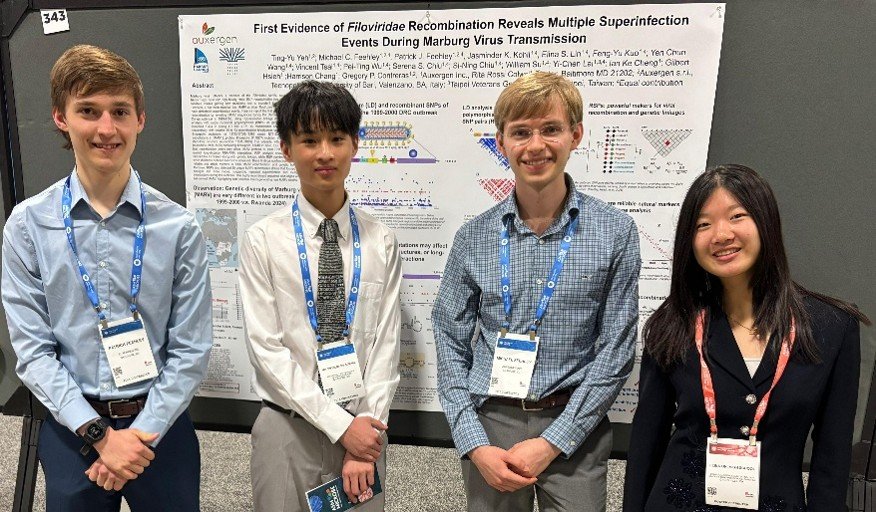
From Left to Right: Patrick Feehley, Ian Cheng, Michael Feehley, Elina Lin.
These findings overturn the prior consensus that filoviruses do not recombine naturally. Instead, this work demonstrates how multiple superinfection events can reshape key viral proteins, RNA structures, and long-distance interactions during an outbreak event.
Auxergen’s findings improve our understanding of transmission dynamics, outbreak tracking, and countermeasure design. The study also validates recombinant SNP pairs and haploblocks as robust, error-resistant markers for tracing viral lineages. This work adds to our previous body of work in the field.
Discovery of a Novel Iron-Binding Protein Encoded by Trichomonas vaginalis Viral Satellites
Auxergen characterized a previously unknown protein (p7) encoded by satellite RNAs in the Trichomonas Vaginalis virus (TVV). This is the first iron-binding protein identified in any virus. p7 binds both Fe²⁺ and Fe³⁺ through a histidine/cysteine pocket and contains a conserved Sx(I/L)P motif that enables direct interaction with host microtubule end-binding proteins (EB1/EB2). This research shows how environmental iron levels may regulate RNA transport in TVV, opening new avenues for therapeutic intervention.
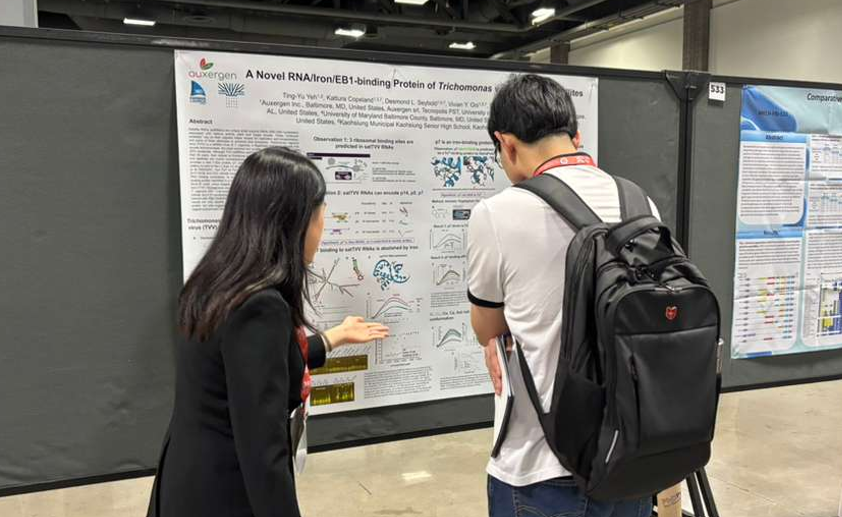
Vivian Ooi presenting to an attendee.
“These presentations on the natural recombination in Filoviridae and the discovery of the first iron-binding viral protein are quite significant.” Dr. Ting-Yu Yeh, Chief Scientific Officer at Auxergen, said, adding: “Both offer new insights to equip the scientific community as they track emerging pathogens and uncover new biological mechanisms.”
About Auxergen
Auxergen, Inc. is a biotechnology company dedicated to harnessing viral mechanisms and bacteriophage technology to address critical challenges in human health, agriculture, and environmental sustainability. Headquartered at the Institute of Marine and Environmental Technology (IMET) in Baltimore, Maryland, the company integrates rigorous virological research with translational development to create innovative therapeutics, diagnostics, and biocontrol solutions. For more information, visit auxergen.com.
The American Society for Microbiology
(ASM) is a professional organization committed to advancing the microbial sciences through rigorous research, peer-reviewed publishing, and global scientific collaboration. ASM supports a diverse network of researchers, educators, and health professionals by fostering innovation, providing professional development opportunities, and advocating for equitable representation across the scientific ecosystem.
Media Contact
Auxergen
Michael Feehley
Email: michael@auxergen.com
Phone: (443)-929-9757